Rather than the medieval Gaelic lordship centred around the tower house, the estate increasingly operated as a Protestant landed estate.
The old O'Dea castle itself, however, was no longer the principal residence.
It gradually deteriorated.
The most important contemporary description comes from the Ordnance Survey work undertaken by John O’Donovan and Eugene Curry in 1839.
Their observations are particularly valuable because they record the castle before its modern restoration.
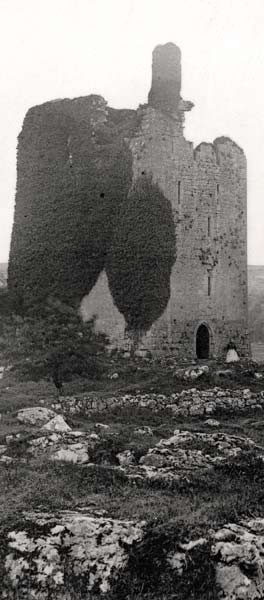
John O’Donovan's description, 1839
He described:
-
A building measuring approximately 22 feet 3 inches long by 15 feet 5 inches wide internally.
-
Walls approximately seven feet thick.
-
Twenty-eight loopholes and small windows.
-
A large window with stone sashes high on the east side.
-
A smaller window high on the west side.
-
Three surviving vaulted floors.
-
Well-made fireplaces of cut and polished stone.
-
A staircase of ninety-six stone steps ascending through the north-east angle.
He also noted that the lower part of the castle was inhabited by a poor family at the time of his visit.
The building had therefore passed through several stages:
-
A Gaelic lord's fortified residence.
-
A contested property during the changing political circumstances of the sixteenth and seventeenth centuries.
-
A damaged and partially occupied structure.
-
A historic ruin.
The nineteenth-century condition
By this period, much of the castle's original internal arrangement had been lost or altered.
The surviving vaulted rooms and fireplaces nevertheless allowed O’Donovan to appreciate the quality of the original construction.
His comments about the large rooms being suitable for the reception of a family of some pretensions are particularly revealing. They suggest that, even in its ruined condition, the castle retained a sense of its former status and scale.
The Great Famine and the landlord landscape
The Great Famine devastated rural Clare.
Dysert and the surrounding parish were part of a predominantly agricultural landscape in which the relationship between landlords and tenants was increasingly strained.
The Synge family's position as landlords therefore needs to be understood within the wider context of:
-
absentee/proprietorial landholding
-
Protestant landlordism
-
Catholic tenant farmers
-
religious divisions
-
poverty
-
eviction
-
the Famine
-
land agitation later in the century
The wider Dysert archaeological trail preserves evidence of this later landscape, including landlord houses, tenant structures, roads and the remains of the Synge estate.
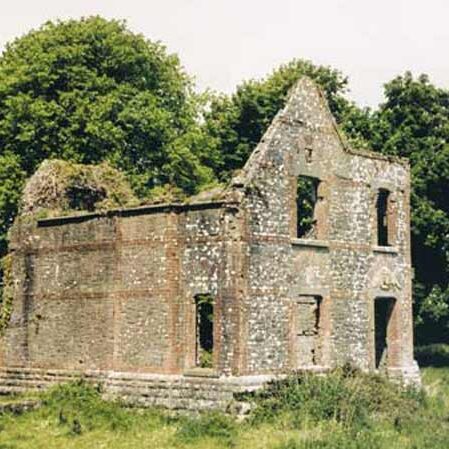
Synge's Lodge
One is Synge's Lodge, a Georgian-style building associated with the landlord family.
The heritage trail records that the lodge was constructed in the 19th century and retains a carved Synge coat of arms above the entrance.
The family motto was:
Caelesta Canimes
— traditionally translated as "We will sing in Heaven."
The Synge family is also connected by name to the famous Irish playwright John Millington Synge, although one should distinguish the wider family genealogy from assumptions about his personal connection to Dysert itself.