The Anglo-Norman army was led by Richard de Clare, a powerful lord associated with the de Clare settlement at Bunratty.
The Gaelic forces included the O'Deas, O'Briens, MacNamaras and O'Hehirs.
In 1318 Richard De Clare decided to try and conquer the North and West of Thomond. He marched his army of about 600 horses and 2,000 foot soldiers to Ennis and Ruan and turned west to Dysert, the home of the O Dea's one of the most powerful clans in County Clare at the time.
Here he divided his army into three parts, the third party under his own command were to attack Dea 's stronghold at Dysert.
He met a small bodv of 0’Dea troops at a ford on the stream where Macken Bridge now stands on monring of the 10th of May 1318. The O’Dea’s pretended to retreat over the ford and De Clare in his enthusiasm for victory rushed across after them with some Knights cutting himself off from the main body of his troops. ODea's men who lay an ambush fell upon De Clare and killed him before he could be rescued by his own men. It is said he was felled by the axe of Conor O Dea himself. Many influential English knights were killed in the battle and Clare remained free of English domination for another two centuries.
The O’Deas played a major role in the battle. Conchobhar O’Dea is credited in the historical tradition with making an important assessment of the opposing forces and helping to direct the Gaelic response.
The victory was a significant moment in the struggle for control of Thomond. It helped maintain Gaelic political power in the region for a further period and strengthened the historical association between the O’Deas and Dysert.
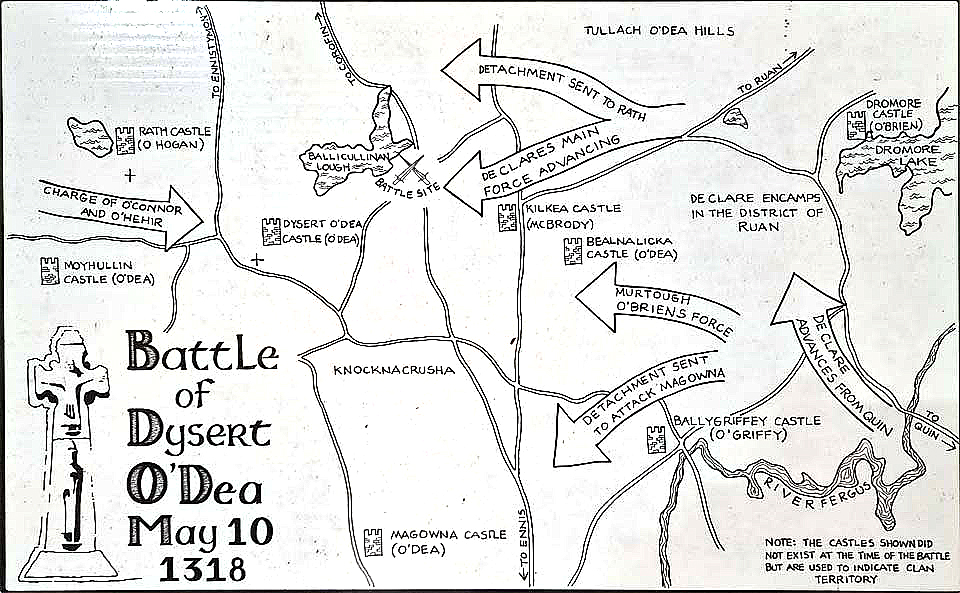
The Irish forces defeated the Anglo-Norman army, and Richard de Clare was killed.
The significance of the battle goes beyond the immediate fighting.
The defeat severely checked Anglo-Norman ambitions in Thomond and allowed the Gaelic political order to remain dominant in much of the region for a considerable period.
The significance for the castle: the battle did not involve the present tower house, which was built roughly 160 years later. However, it helps explain why Dysert was such an important location for the family. It was a place associated with their territory, their religious connections and a major military victory.